
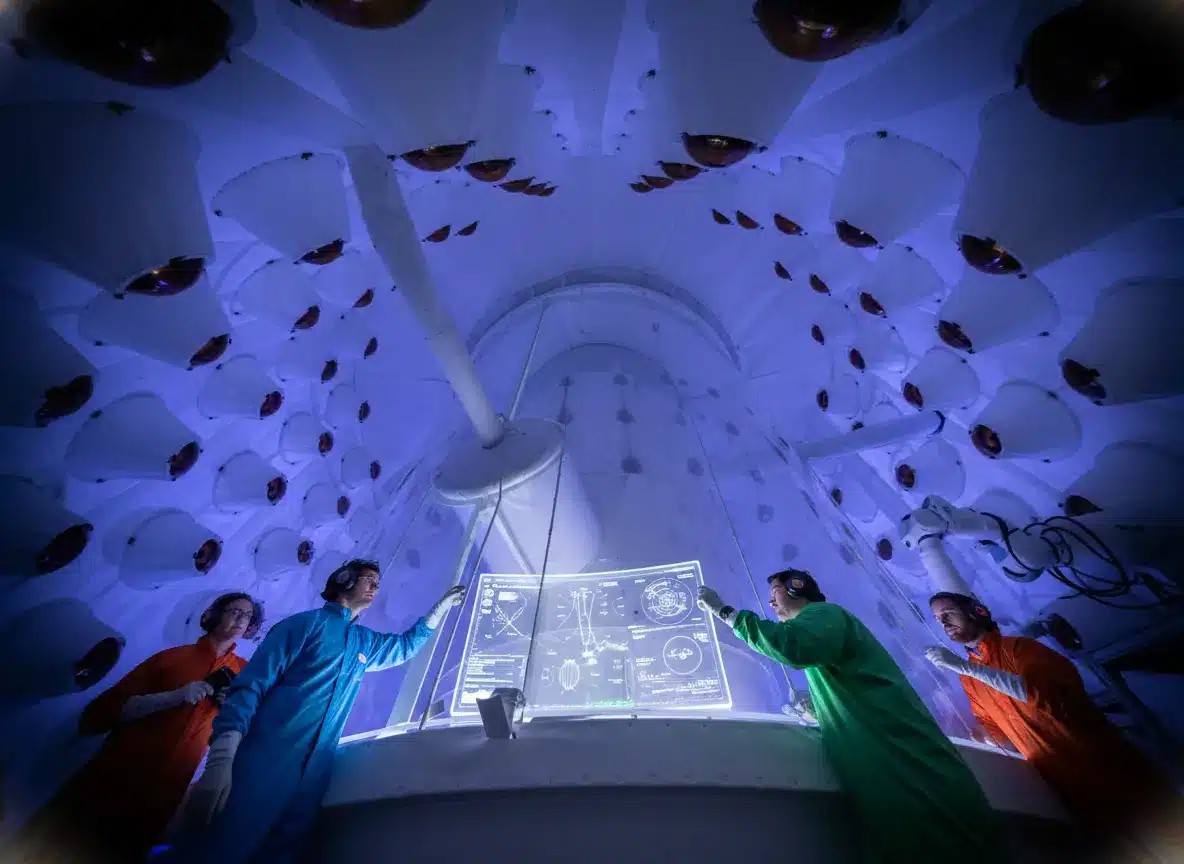
Deep below the Dakota plains, shielded from cosmic noise and earthly distractions, scientists are tunneling into the greatest secret of the cosmos: What is dark matter? If you imagined a flashlight, some enthusiasm, and a “Gone Exploring” sign, think again. The LUX-ZEPLIN (LZ) project, set more than a kilometer underground, is mobilizing leading-edge technology—and a determined team of over 250 scientists—to set new boundaries in the pursuit of this cosmic mystery.
Unearthing the Cosmos: The LUX-ZEPLIN Project
At the Sanford Underground Research Facility in South Dakota, almost a mile beneath the surface, LUX-ZEPLIN quietly works where even the noisiest cosmic rays can’t reach. Its mission is nothing short of heroic: investigate the invisible dark matter that makes up most of the universe’s mass. Modern physics might be full of wild ideas, but understanding dark matter remains a riddle of cosmic proportions.
LUX-ZEPLIN is celebrated as the world’s most sensitive detector of its kind. Why all this fuss over invisibility? Because, for decades, scientists have been sure dark matter exists. It shapes galaxies. It holds the cosmic structure together. Yet, try as we might, direct detection has remained tantalizingly out of reach.
The LZ experiment sharpens the search for one especially enticing dark matter candidate: Weakly Interacting Massive Particles, or—as physicists lovingly call them—WIMPs. Hugh Lippincott, an experimental physicist at the University of California, Santa Barbara, captures the hunt’s spirit: “We always hope to discover a new particle, but it’s just as essential to set boundaries on what dark matter might be.” Turns out, ruling things out can be as thrilling as finding them.
The Heart of the Machine: Technology at Depth
Let’s talk hardware. The LZ detector is a technological masterpiece featuring two robust titanium vessels filled with 10 metric tons of ultrapure liquid xenon. Why xenon? Because it’s both dense and silent, making it ideal for capturing the faintest flash—those tiny bursts of light that might signal a WIMP colliding inside. Surrounding this silent heart, an outer detector loaded with gadolinium-boosted liquid scintillator serves as a bouncer at the nightclub, weeding out background noise and letting the real signals through.
- Layer upon layer blocks outside radiation
- Thousands of low-radioactivity parts minimize natural interference
- External detector (OD) helps distinguish authentic WIMP signals from lookalike background events
What’s the biggest foe? The humble neutron. Present in nearly every atom, it skillfully impersonates WIMPs in the data. To tackle this, UCSB scientists led the design of the external detector, vital for filtering neutron interactions and zeroing in on authentic discoveries.
An Ocean of Data—and a Pinch of ‘Salt’
The LZ team recently analyzed data spanning 280 days: 60 days from the initial operational phase plus another 220 from March 2023 to April 2024. And they’re not done yet—by 2028, they’re aiming for a whopping 1,000 days of scientific scrutiny in total.
But data alone isn’t enough. To ensure humanity’s famously unreliable subjectivity doesn’t slip in, the collaboration uses a clever method known as “salting.” During the data collection, they intentionally introduce fake WIMP signals. Only after all analyses are complete—and it’s time to “desalt” the dataset—do scientists reveal which events were genuine. It’s a little like testing a magician for sleight of hand by adding a few decoy cards to the deck.
“We’re exploring a region where no one had ever looked before,” explains Scott Haselschwardt, study coordinator. “When working at the boundaries of knowledge, it’s essential to keep your objectivity.”
Redrawing the Map of the Universe
So, where does LZ leave us? The team’s new results put much tighter limits on what WIMPs might be, helping blow away false models of the universe and setting a sharper course for future dark matter hunts. But the value extends even further: the detector can also spot rare events, like solar neutrinos or unusual decays of xenon isotopes, making it a cosmic Swiss Army knife of physics discovery.
This is no solo quest. The LUX-ZEPLIN collaboration unites scientists from 38 institutions across six countries. Looking ahead, preparations are underway for XLZD, the next-generation detector. Every day brings us closer—one silent, data-packed shift at a time—to grasping what binds the cosmos together.
In the deep quiet below the Dakota rock, science is listening. And in that listening, inch by patient inch, we’re rewriting what we know about the hidden universe. Stay tuned—the darkness might just talk back.

John is a curious mind who loves to write about diverse topics. Passionate about sharing his thoughts and perspectives, he enjoys sparking conversations and encouraging discovery. For him, every subject is an invitation to discuss and learn.